The Car That Will Outlive Its Software
Published on January 21, 2026 | Category: Technology
The car doesn't feel old.
It starts without complaint. The engine note hasn't changed. The doors still close with that soft, engineered finality that made you believe you'd bought something solid, something future-proof.
Then, one day, you plug in your phone.
The screen takes a second longer than usual. Maps loads, but hesitates. A familiar app refuses to connect. You blame the cable. Or the network. Or the phone. Anything but the car.
Because the car is supposed to last.
The Digipad Paradox
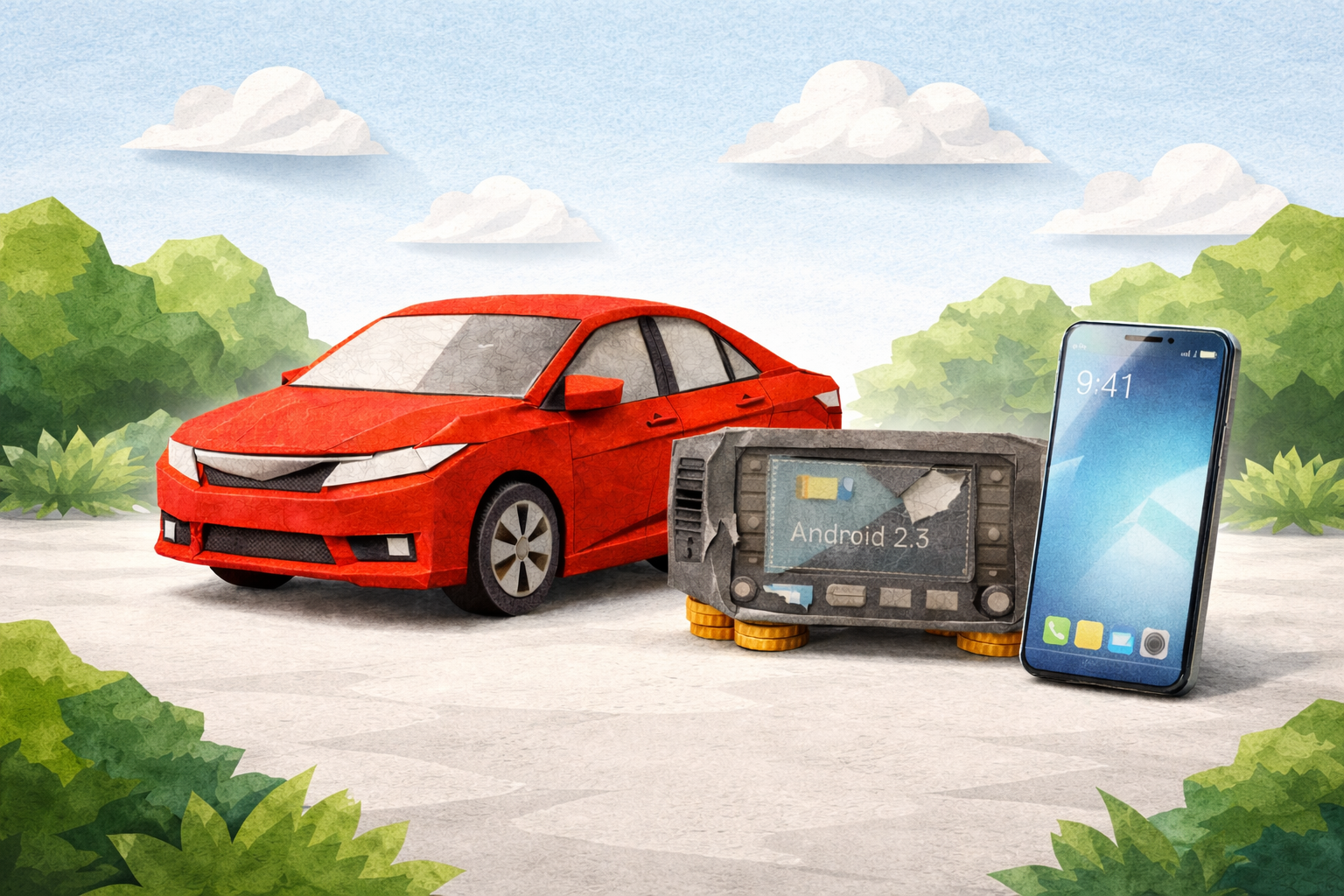
I know this because I bought a Honda City in 2018. Along with it came something the sales executive was visibly more excited about than the engine itself: the Honda Digipad. He spoke about it the way people speak about their first smartphone. Touchscreen. Android-powered. Smart.
Years later, curiosity got the better of me. I dug into the system settings.
Android 2.3.
In 2018.
The car, meanwhile, remains annoyingly reliable. Solid. Comfortable. Mechanically honest. It has aged like a responsible adult while its software seems to have been born old.
And it hasn't changed since. No updates. No patches. No gentle "your system is no longer supported" message. Just quiet, dignified stagnation.
The Mismatch
This is where the mismatch begins.
Cars are built to survive years of abuse, heat, dust, potholes, bad fuel, worse roads. We measure their lives in decades. We take loans that run longer than some careers because the machine itself feels worthy of that faith.
Software does not share that worldview.
The Android ecosystem inside cars lives on a timeline closer to smartphones, except without the promises. Your phone comes with commitments now—five years, seven years, security patches you don't notice but rely on. Even obsolescence is planned.
Your car makes no such commitment.
When software support stops, nothing dramatic happens. The screen doesn't go black. The music doesn't stop mid-song. That's the trick. It continues working just well enough for you to stop thinking about it.
Meanwhile, the system keeps talking to the outside world. To phones. To networks. To cloud services. Every connection is a small open window. When security patches stop, those windows don't slam shut. They just stay… open.
The Software-Defined Future
Automakers didn't design themselves for this problem. Software was once an accessory, not a responsibility. Updates meant recalls. Change was slow. Once a car shipped, the code inside it was meant to sit still and behave.
That is precisely what the industry is now trying to undo.
Enter the idea of the software-defined vehicle, or SDV, as it's now breathlessly called in boardrooms and keynote slides. The promise is simple: treat software as the product, not the afterthought. Build cars on long-lived software platforms. Push updates over the air. Decouple features from hardware. Make a vehicle that improves with age instead of quietly freezing in time.
In theory, SDVs could close the gap. A car platform that is updated like an operating system could receive security patches for as long as the vehicle remains on the road. Bugs wouldn't wait for service intervals. New features wouldn't require new hardware. Software lifecycles could finally start resembling the physical lifecycles they sit inside.
In practice, this is harder than the slides suggest.
Cars are not phones. They carry regulatory weight, safety implications, and legal liability that make every update slower, heavier, and riskier. A bad app update bricks a phone. A bad vehicle update can brick trust, or worse.
So SDV is not a switch that gets flipped. It's a decade-long re-architecture, one that requires carmakers to become software companies without forgetting that they are also responsible for two-ton machines moving at highway speeds.
Which means the cars already on the road, including mine, will never fully benefit from it.
The Ticking Clock
For them, the software clock is already ticking.
Security patches will stop.
The car will stay.
Until policy steps in, perhaps the NGT deciding that fifteen years is suddenly too long, and ends the story for reasons that have nothing to do with engineering or upkeep.
The irony is sharp. The software ages out quietly. The hardware remains road-worthy. And the future of the vehicle may be decided neither by wear nor by risk, but by regulation filling a vacuum that software support left behind.
SDVs might fix this, eventually. But they also quietly admit something the industry has avoided saying out loud: the old way of building cars was never designed for a world where software mattered this much.
A Question of Trust
This isn't about frozen screens or laggy maps. It's about trust. We trust cars with our families, our commutes, our lives, while accepting that the digital layer underpinning that trust is allowed to expire without conversation.
That mismatch isn't loud. It doesn't trend. It doesn't break down on the highway.
Which is exactly why it should worry us more than it does.