Data: India’s New Oil, Controlled by a Quiet Duopoly
Published on May 10, 2026 | Category: Technology
Imagine waking up in a small town in Uttar Pradesh. You open your phone to check the weather, scroll through news while sipping chai, order groceries, and video-call your daughter studying in Bengaluru. Every tap leaves a trace. That trace - your location, preferences, conversations, fears, and aspirations - has become the most valuable resource of our time. Not oil beneath the desert. Not minerals in the earth. But data, flowing invisibly through the air around you.
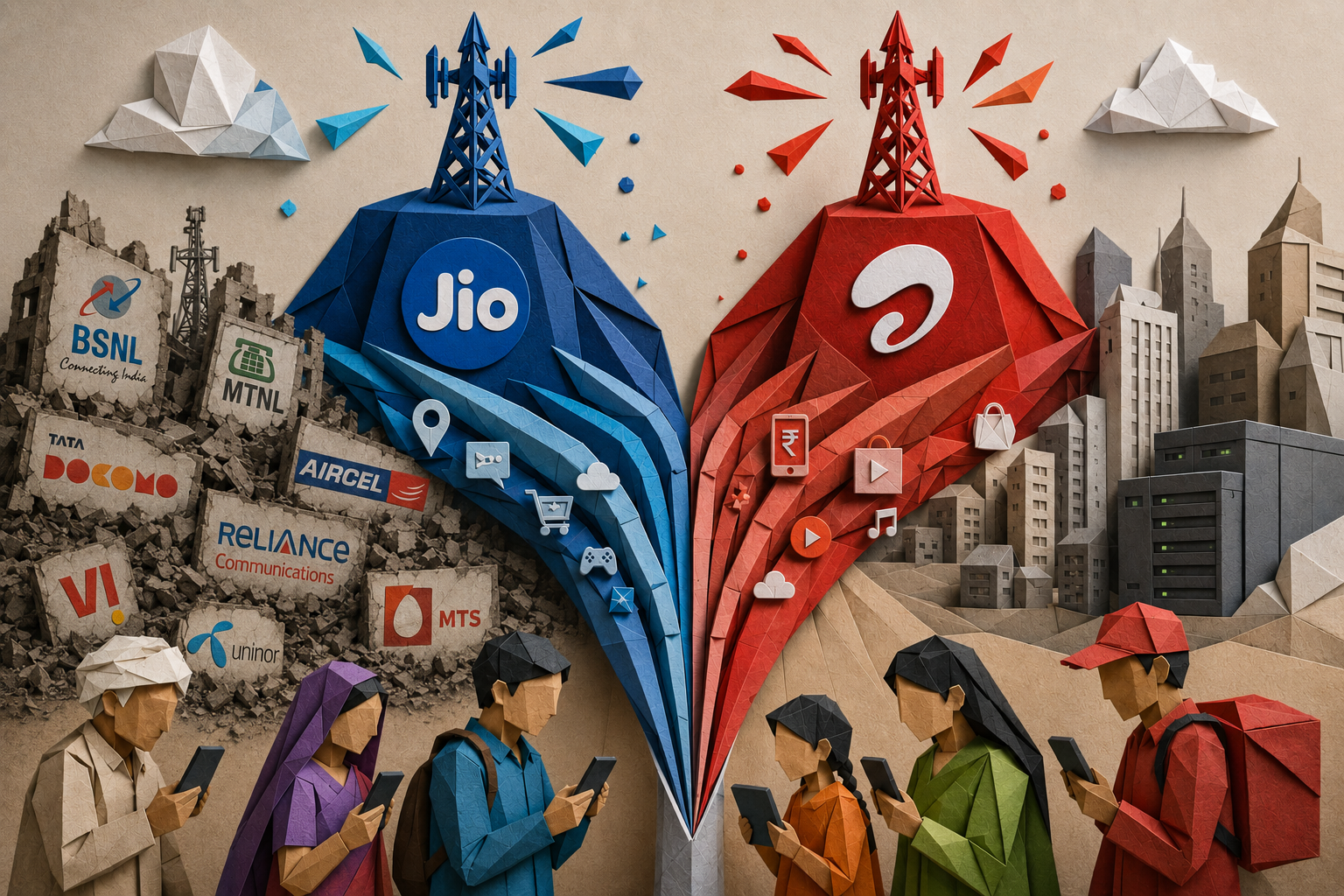
And in India, the pipelines carrying this resource are increasingly controlled by just two companies: Reliance Jio and Bharti Airtel.
The Slow Vanishing of Choice
A decade ago, the market felt crowded. State-run BSNL and MTNL connected remote villages when private players hesitated. They carried the burden of universal service - wiring the unreachable. Then Jio arrived in 2016 with rock-bottom prices and an entire digital ecosystem. The industry changed overnight. Tariffs crashed, millions came online, and India’s data revolution truly began.
Today, the picture has shifted. BSNL, despite repeated government revival packages worth lakhs of crores - including fresh capital for 4G rollout and spectrum support - struggles to keep pace in the mobile space. It retains relevance in fixed-line broadband and some rural pockets, but its overall influence has shrunk dramatically. The private giants now dominate wireless connections.
For ordinary Indians, this means the pipes delivering the internet - the gateway to jobs, education, entertainment, and government services - run through private hands. Two sets of hands, to be precise.
A Day in the Life of Your Data
Take Rajesh, a delivery executive in Mumbai. His Jio SIM tracks his routes for efficient deliveries. The same connection lets him stream cricket on JioCinema during breaks and shop on JioMart. His patterns - where he goes, what he watches, what he buys - feed back into one sophisticated ecosystem. Airtel users experience something similar through their own bundled services and premium network.
This isn’t abstract. Telecom operators sit at the narrowest point of the digital funnel. They see the metadata of calls, messages, locations, and app usage. With consent frameworks and integrated apps, they access even richer behavioral portraits. This data powers everything from targeted ads to credit decisions to the next generation of AI models.
Users rarely notice the exchange. Data plans still feel relatively affordable compared to many countries. Speeds have improved with 5G. But questions linger: Who really owns this intimate picture of our lives? How freely does it move? And what happens when AI enters the refinery?
The Rising Price of Access
The era of ultra-cheap data that pulled hundreds of millions online is quietly ending. After years of brutal price wars, Jio and Airtel have begun selective tariff increases. Entry-level plans have been adjusted or discontinued in some cases. For millions of low-income and rural users who powered the original boom, monthly bills are creeping up.
It is the classic duopoly dynamic: once competition thins, the focus shifts from grabbing users to extracting more value from them. The same companies that democratised connectivity are now premiumising it.
Gatekeepers of Attention and Ambition
Beyond raw data lies something subtler: control over what we see and when. These operators decide network priorities, bundle certain apps, and increasingly shape the advertising layer that funds much of the internet. They are positioning themselves to challenge global ad giants using their own first-party data and vast reach.
In an election season or during a public health scare, the algorithms deciding which news or alert appears first carry real weight. It is not crude censorship. It is quiet curation at the infrastructure level.
AI: The Accelerator
The game is changing faster with artificial intelligence. Both Jio and Airtel are pouring billions into data centres and AI partnerships. Airtel is building massive AI hubs with global tech players. Jio is integrating AI deeply across its services. Your usage patterns train these systems, which in turn offer smarter recommendations, better network performance, and more personalised experiences - creating even tighter loops of data collection.
Suddenly, the companies that know your daily rhythm best are also best positioned to build (or feed) powerful Indian AI models. The refinery is being upgraded, and the crude keeps flowing.
Sovereignty, Privacy, and the DPDP Guardrails
The Digital Personal Data Protection Act and its rules bring some reassurance - consent requirements, purpose limitations, breach notifications, and penalties. Telecom operators, as major data fiduciaries, face new obligations. Yet industry bodies have flagged practical challenges around implementation, especially for minors’ data on family SIMs and cross-border flows.
Jio has long pushed for strong data localisation - keeping Indian data in India. Concerns about potential leaks or foreign access persist in public discourse. In a world of geopolitical data tensions, who holds the master keys matters.
Are We Still in Control?
India has gained enormously. Cheap data sparked entrepreneurship, education access, and digital public goods like UPI. Billions of connections have transformed lives. The two giants have invested massively and delivered scale few countries match.
But agency is slipping. Ecosystem lock-in makes switching feel harder than just changing a SIM. Portability exists for numbers, but your history, preferences, and convenience often stay behind. Public alternatives have weakened. True competition - through more MVNOs or stronger smaller players - remains limited.
Globally, China keeps tight state oversight. Europe emphasises strict regulation. India’s path - massive private scale with emerging rules - is unique. The stakes are higher because of our population and the speed of digitisation.
What Comes Next
We are not powerless. Stronger enforcement of data protection, genuine interoperability, transparent AI practices, and vigilance on network neutrality can restore balance. Supporting viable public options where they make sense, encouraging new entrants, and demanding clearer transparency reports from operators are practical steps.
As citizens, we can start small: review app permissions, use privacy features, and stay aware that every scroll is currency.
Data is India’s new oil. The rigs are built, the flow is accelerating, and the refineries are getting smarter. The question is whether we - as a democracy - will ensure the benefits are shared broadly, or whether a handful of pipelines will quietly decide the contours of our digital lives for decades to come.
The taps are open. The meter is running. Awareness is the first valve we can still control.