The annual gridlock at Kalindi Kunj is not a traffic problem. It is a governance choice.
Published on August 8, 2026 | Category: Politics
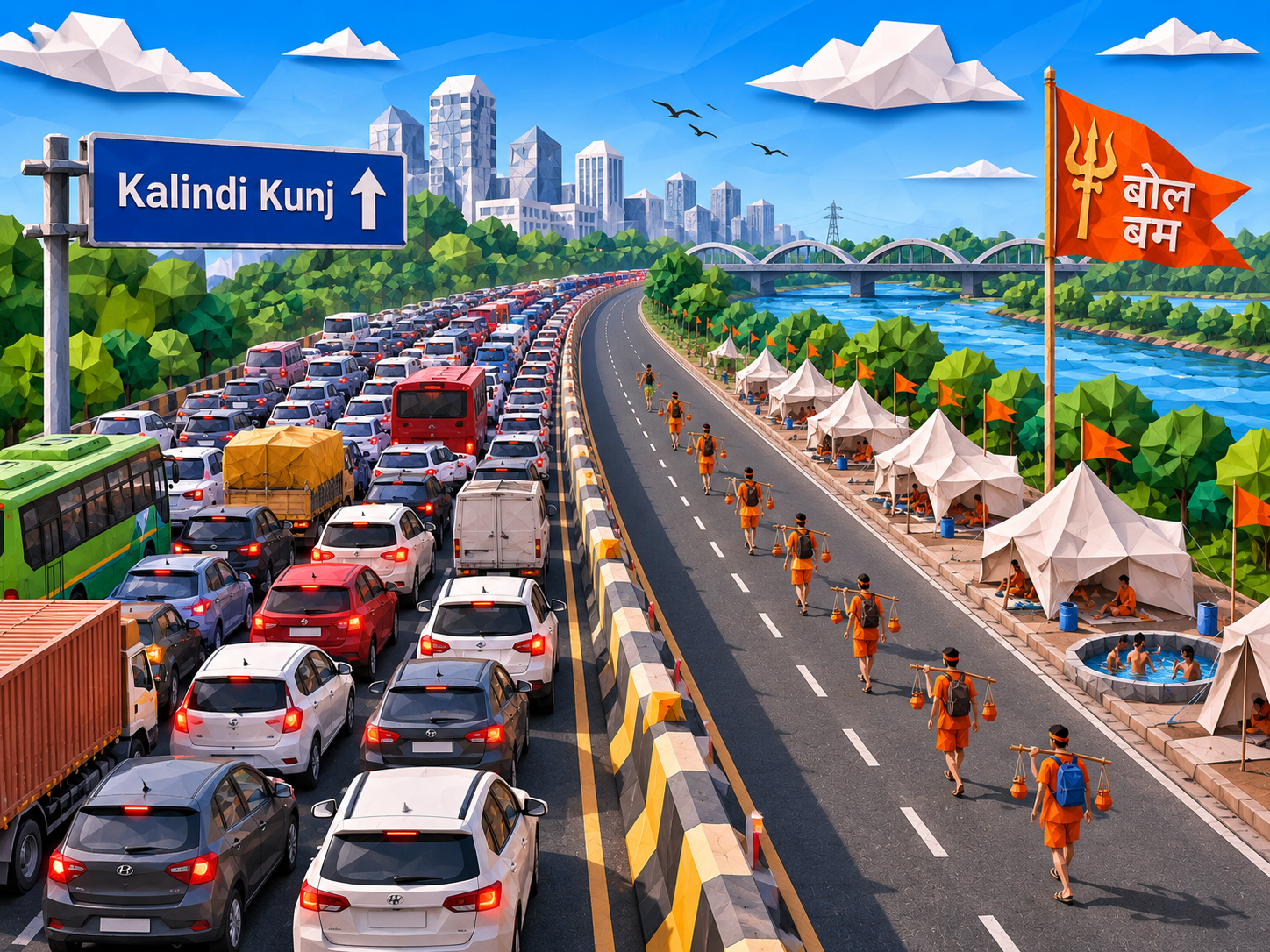
Every year, as the monsoon settles over the National Capital Region, a familiar ritual unfolds at one of Delhi’s most stubborn bottlenecks. Lanes on the Kalindi Kunj carriageway-already strained by the daily crush of office-goers, commercial vehicles, and the after-effects of the Delhi-Mumbai Expressway-are quietly reserved for Kanwar Yatris. What was once a 20-minute hop between Sarita Vihar and Noida stretches into two-hour stands. Tailbacks snake back to Shaheen Bagh. Commuters sit in idling cars, recalculating their days. The city absorbs the cost without protest.
This is not an accident of religious fervour meeting urban density. It is the predictable outcome of a system that treats certain claims on public space as non-negotiable while treating the mobility of everyone else as residual.
The bottleneck that never sleeps
Kalindi Kunj was never designed for generosity. The intersection sits at the awkward junction of southeast Delhi, Noida, and Faridabad traffic. The opening of a stretch of the Delhi-Mumbai Expressway only intensified the pressure, pulling more vehicles onto the same narrow bridge and approaches. On ordinary days the junction already runs at capacity. During the Kanwar Yatra, authorities respond by cordoning off one or two of the four lanes on the Noida-bound side between Okhla Barrage and the Bird Sanctuary. The remaining lanes must absorb the displaced volume.
The result is measurable, repeated, and well-documented. In July 2024, two of four lanes were blocked and two trucks broke down; tailbacks stretched over 3 km back to Shaheen Bagh. In July 2025, Rajeev Sharma, a private firm employee commuting from Sarita Vihar to Noida Sector 63, reported the journey took him double the usual time. “I was stuck near Kalindi Kunj for 30 minutes. Closing lanes during peak hours without proper diversion plans is just poor planning,” he told reporters. Another regular, Vikas Kumar, put it more bluntly: “Traffic gets worse every year during the Kanwar Yatra. The police should find an alternative.”
In August 2026 the pattern repeated. A journey that once took 10–30 minutes was reported taking two to two-and-a-half hours. Social media filled with videos of stationary metal rivers; one comparison circulating online claimed navigating the Kalindi Kunj jam was harder than the Strait of Hormuz. Cab drivers described passengers missing medical appointments. Ambulances appeared in viral footage, trapped behind red buses.
The official response is managerial. Police issue advisories, deploy additional personnel, and urge the public to use the DND Flyway or the metro. The language is calm. The underlying allocation of rights is not.
When the road becomes a stage
The friction is not limited to delayed office hours. In South Delhi, the peak of the yatra has repeatedly turned arterial roads into something closer to open-air party zones. Residents in Kalkaji, Khirki Extension, Saket, Greater Kailash, CR Park and Friends Colony have described the experience in stark terms.
Anjali Raina of Kalkaji recalled: “This was not devotion. This was anarchy on two-wheelers. Young men were racing down narrow lanes, hitting cars with sticks, screaming, blocking intersections, but no one from the police even showed up.” Ashish Gupta of Khirki Extension said a group began dancing with blaring music in the middle of the road while he sat with his children in the car: “They treated the road like their private stage and dared anyone to object.”
Trucks fitted with massive DJ setups park mid-road. Groups occupy both lanes and footpaths. Waste piles up after the feasting. In Friends Colony East, RWA secretary Triveni Mahajan has repeatedly flagged late-night processions along Mathura Road: “The movement of Kanwariya trucks fitted with high-volume sound systems has begun and residents… are already experiencing considerable disturbance.” In 2025, Delhi Police recorded more than 200 complaints over a single weekend related to noise and traffic. Some neighbourhoods reported four to five noise complaints daily.
Enforcement, residents and some local leaders argue, often feels performative. Officers stop vehicles and ask for the volume to be lowered or wires cut. Cases of outright violence or hooliganism are less frequently registered. The pattern creates a feedback loop: the more the rules appear optional, the more confidently they are tested.
Classrooms empty, liquor shops open
The costs spill far beyond roads and residential colonies. In early August 2026, district administrations across western Uttar Pradesh ordered schools and colleges shut for up to nine days to facilitate the yatra. In Ghaziabad the closure ran from 4 to 12 August for institutions from nursery to Class 12, as well as colleges, universities and technical institutes. Similar orders covered Meerut, Muzaffarnagar and Baghpat.
School principals told reporters the nine-day break would further shrink an already packed academic calendar. Online classes were described as a poor substitute, especially for younger children who need constant supervision and for students without reliable devices or internet. One parent of a Class 1 student noted that both working parents leave home early, leaving no one to help the child stay focused. A private school principal observed that foundational learning suffers most when the regular classroom routine is broken for so long at the start of the session.
Vijaita Singh, Deputy Editor at The Hindu, captured the broader frustration in a widely shared post: the government had ordered schools shut for nine days due to Kanwariyas while “every other day a new liquor shop pops up in Noida/Ghaziabad/Greater Noida.” The contrast was sharp-education treated as flexible, commerce around alcohol as resilient.
The stated reason for the closures is student safety amid heavy pilgrim movement and traffic diversions. The practical effect is that thousands of children lose consecutive instructional days in a system already struggling with learning gaps, teacher shortages and infrastructure deficits. The same districts that empty classrooms for the yatra continue to expand commercial outlets that face no comparable seasonal pause.
The cost that never appears on a balance sheet
None of this is an argument against the Kanwar Yatra itself. Carrying Gangajal is a legitimate expression of faith practised by lakhs of people. Many pilgrims walk long distances in difficult conditions and receive hospitality along the way. The problem is the absence of a consistent framework for competing claims on finite public resources-road space, quiet nights, and instructional time.
Delhi’s infrastructure is already operating near its limits. Adding a recurring, high-intensity seasonal demand without corresponding dedicated capacity, timed restrictions, or credible deterrence produces the same outcome every year: visible chaos at Kalindi Kunj, sleepless nights in residential colonies, and emptied classrooms across the Yamuna. Office-goers lose hours. Students lose sleep and learning days. Senior citizens and patients lose rest. Emergency vehicles lose time. The city loses predictability-the quiet infrastructure that makes dense urban life possible.
Long-term proposals exist on paper. An elevated flyover to make the Kalindi Kunj junction signal-free has been discussed for years and has received periodic nods. It will not arrive in time for the next Shravan. In the interim, the pattern continues: barricades go up for one group, schools close for safety, advisories go out to everyone else, and the majority of users are expected to absorb the friction.
What a different bargain would look like
A city-and a state-that can distinguish accommodation from abdication would treat the yatra as a logistical problem with clear parameters rather than an annual suspension of ordinary rules. Dedicated parallel corridors away from the most congested arteries. Strict volume limits and real consequences for boombox trucks that ignore them. Visible, consistent enforcement that does not soften because the participants are carrying water for Lord Shiv. Advance planning that does not simply shift the entire cost onto residual traffic and residual classrooms.
Until then, Kalindi Kunj will keep teaching the same lesson every monsoon. The water in the kanwars is treated as sacred. The time of the people stuck behind the barricades, and the learning days of the children whose schools are shuttered, is treated as residual. That imbalance-not the pilgrimage-is the real story of the annual gridlock.