When Ramayan Met DITA
Published on 17 October 2025 | Category: Technical Writing
[A lighthearted take on structured authoring, no offense meant to the great epic and for those unfamiliar, Ramayan is an ancient Indian epic, think of it as the original structured documentation project.]
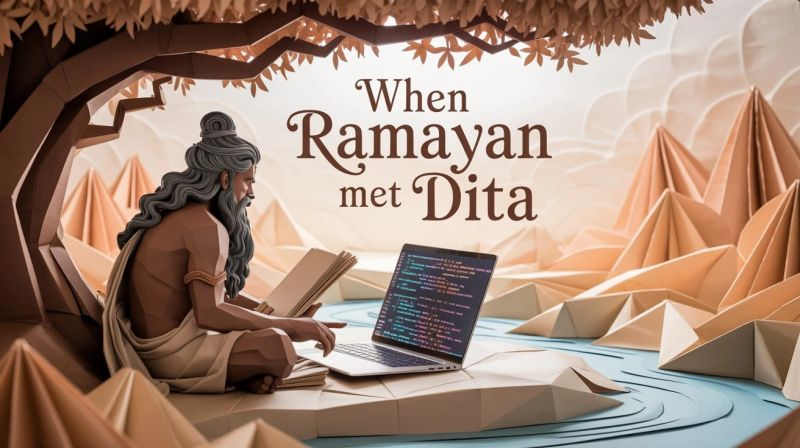
Imagine if the Ramayan were written today.
Not by Valmiki, but by a Technical Writer armed with DITA XML, schema validations, and a 3 month
release deadline.
Let's face it, Valmiki didn't have reuse, conrefs, or a CMS.
He wrote 24,000 verses manually, one by one, with no templates, no peer reviews, and no Jira comments saying "Can you add a diagram for this?"
No SME asking for "just a minor update" that completely rewrites the storyline.
If he had DITA though, the epic might have looked very different.
- Each Kand (book) would be a DITA map.
- Each Yudh (battle) a task topic.
- Each dialogue between Ram and Lakshman would be a reference topic, complete with metadata tags like <emotion>calm</emotion> or <audience>younger_brother</audience>.
- Sita's abduction would have warning notes, caution tags, and probably a task hazard statement like:
Note: Do not wander alone in forests without security support.
And of course, there would be conditional text. Different output for Devs, Humans, and Rakshasas, because not all audiences need the same level of detail.
- The Devs get the Sanskrit version.
- Humans get the Hindi translation.
- Rakshasas get a limited "read only" version, compliance restricted.
Need to reuse "Ram breaks Shiva's bow"?
- Just conref it across multiple deliverables, one for Ayodhya residents, one for Lanka readers, and one in Markdown for mobile users.
And imagine the content review cycle:
- Hanuman: "Can we shorten the Sundar Kand? Too many steps in the 'Find Sita' task."
- Valmiki: "I can't. Compliance says it's mandatory."
- Lakshman: "I'll approve once Ram reviews it."
- Ram: "Waiting on stakeholder feedback from Rishi Vishwamitra."
By the time Ram returns to Ayodhya, the DITA map would have 40000 plus topics, 90 percent reuse rate, and a translation backlog till Treta Yug 2.0.
Even the Bharat and Ram storyline would be a perfect example of content branching, one mainline storyline, one conditional variant, both merged for final output in the "Return to Ayodhya" release.
Version control?
Let's just say the Git repo would have been huge:
Ramayan_v1.0_draft_final_FINAL(ReviewedByRishi).pdf;432mb
And the "Asurs" (demons)? Probably filed a bug ticket:
"Documentation portrays us unfairly. Request neutral tone in next release."
In the end, though, DITA or Sanskrit, the goal is the same:
Clarity. Consistency. Reusability.
Because epics or enterprise docs, if the story isn't structured right, even gods will need a how to guide.