The Real Cost of Convenience
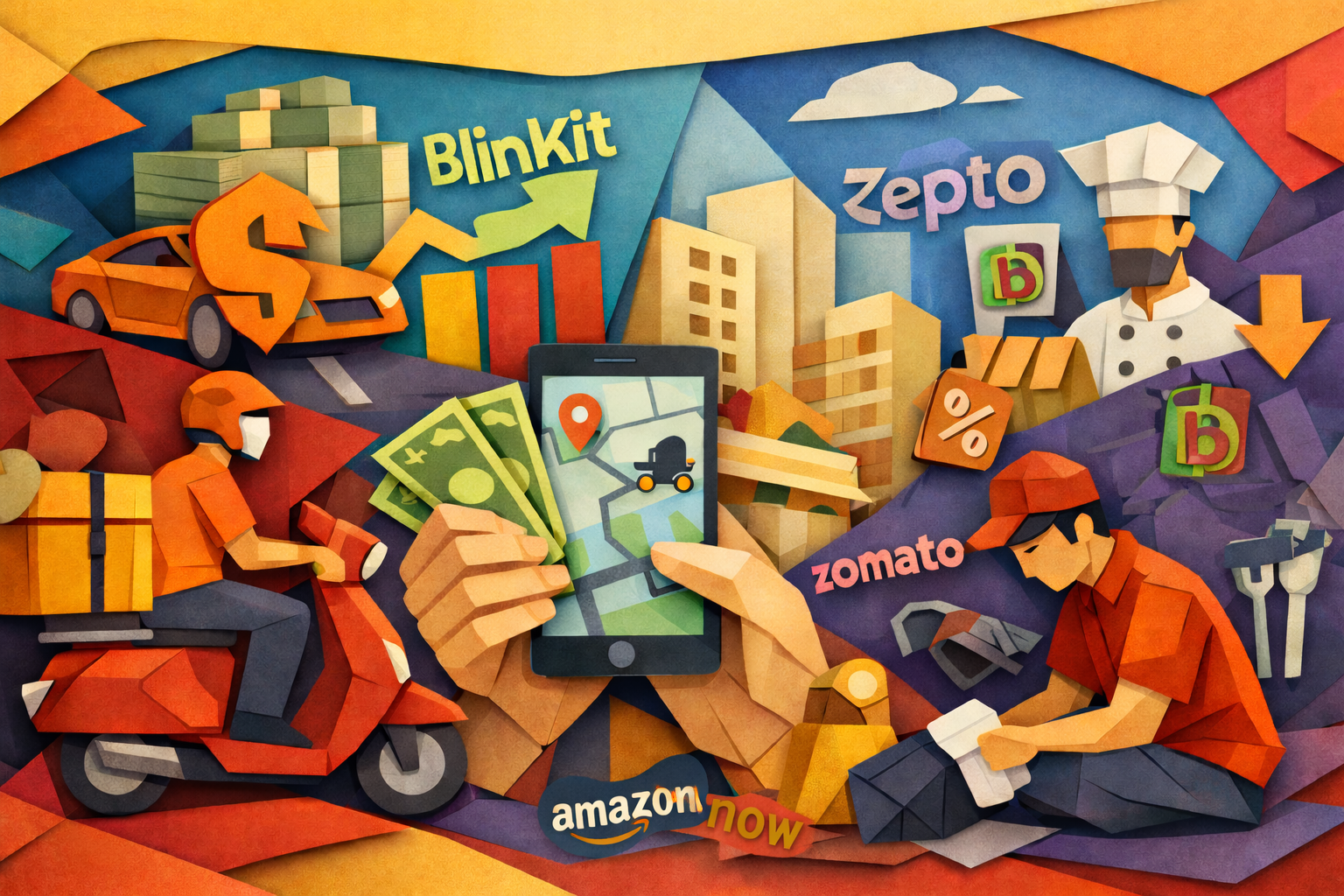
Published on 17 January 2026 | Category: Technology
On most days, India's food and grocery delivery economy feels frictionless. You open an app, scroll through familiar logos, place an order, and within minutes someone shows up at your door. The transaction is clean. The interface is polished. The cost, at least on the screen, appears modest.
This is what platform efficiency looks like to a consumer.
But that smoothness is not accidental. It is the result of a system that carefully decides where stability belongs and where uncertainty should sit. And increasingly, the people placing orders are missing the larger picture of how this system reshapes work, pricing, and risk across the economy.
Platforms don't sell food. They sell coordination.
Companies like Zomato and Swiggy are often described as food-delivery businesses. They are not. They don't cook food, own kitchens at scale, or employ delivery workers in the traditional sense. What they operate instead is a coordination layer, connecting restaurants, consumers, and delivery partners through software.
Their core strength lies in demand aggregation, logistics routing, and local density. Faster delivery is not primarily achieved by asking delivery partners to ride faster, but by placing stores closer to customers, batching orders, and optimizing routes. This distinction matters, because it reframes the debate. Speed is not the product. Density is.
And density is what platforms monetize.
The three-sided transaction
Every order on a food or quick-commerce app involves three parties, each paying in different ways.
Consumers pay through delivery charges, platform fees, and increasingly through subscriptions such as Zomato Gold or Swiggy One. These memberships promise benefits like free deliveries or exclusive offers. The amounts involved are usually small enough to feel negligible. But subscriptions change behaviour. Once a user has paid upfront, ordering more frequently feels like extracting value rather than spending more.
Restaurants pay commissions and often participate in platform-led discounts to remain visible. The exact commission rates vary by city, category, and negotiation power, but the pressure is consistent: visibility on the platform is not free. Many restaurants raise menu prices on apps to offset these costs, which consumers indirectly absorb.
Delivery partners absorb a different set of costs altogether. Fuel, vehicle maintenance, downtime, traffic delays, and weather-related disruptions are largely borne by the individual. Earnings fluctuate based on time of day, order availability, and incentive structures that change frequently.
Each participant pays a small price. The platform collects at scale.
Subscriptions don't lower prices. They stabilize demand.
From a consumer's perspective, subscriptions feel like savings. From a platform's perspective, they reduce uncertainty. Predictable demand improves planning, increases order frequency, and strengthens retention. What subscriptions do not do is fundamentally lower the cost of food or delivery. Restaurants still pay commissions. Delivery partners still face variable earnings. The system becomes more predictable, but mostly for the platform.
The cost to the consumer is not per order. It is behavioural.
Flexibility, but on whose terms?
Much of the public debate around gig work hinges on voluntariness. Delivery partners are not forced into the system. Many choose it because it offers flexible hours, faster cash flow, and fewer entry barriers than formal employment. High attrition rates reinforce the idea that this is temporary work.
But choice does not exist in a vacuum. In an economy where informal labour dominates and social security is limited, flexibility often comes bundled with instability. Earnings vary. Algorithms decide order allocation. Ratings affect access to work. Deactivations can happen with limited recourse.
Insurance coverage exists, as platforms frequently point out. But insurance addresses what happens after harm occurs. It does not answer who bears daily exposure to risk. The distinction matters.
The wrong argument about speed
Public outrage has focused heavily on 10-minute delivery promises. Whether delivery partners are explicitly pressured to rush misses the larger issue. Risk in these systems doesn't come from timers alone. It comes from how uncertainty is distributed.
Traffic jams, sudden rain, road conditions, and order surges are all variables the system must absorb. Platforms protect themselves through dynamic pricing, incentives, and flexible labour supply. Delivery partners absorb variability through longer hours, faster decisions, and physical exposure.
Efficiency improves when variability is pushed downward.
Restaurants stay because leaving is worse
Restaurants, especially smaller ones, remain on platforms not because margins are healthy, but because discovery has shifted. Platforms control access to demand. Opting out often means invisibility. Discounting becomes a necessity, not a strategy. Bargaining power tilts toward the intermediary.
This is not unique to food delivery. It is a familiar pattern in platform economies. Control the customer relationship, and everyone else adjusts.
Where stability accumulates
The financial upside of this model is not evenly distributed. Platforms benefit from recurring subscription revenue, improved unit economics, and investor confidence tied to engagement and retention. Workers churn. Restaurants adapt or exit. Consumers pay incrementally more while feeling rewarded.
This is not a story about individual greed. It is about incentive design.
A broader economic shift
India did not formalize labour through apps. It digitized informality. Work became trackable, optimizable, and scalable, without becoming secure. Consumption grew. Stability did not.
Convenience has a cost. It is just rarely paid by the person clicking "order now."
The system works. The question is who it works for, and who absorbs what it leaves unresolved.